I remember watching Project Blue Book on TV as a kid, the show that walked through different cases of potential UFO and extraterrestrial encounters week by week. Back then, every sighting seemed to get the same kind of explanation: swamp gas, light refracting off something, the Air Force testing flares, or some other deflection. Fast forward a few decades, and the Pentagon has released videos of things in our skies that we can't identify. Now we call them UAP, and the term that gets thrown around alongside them is interdimensional beings.
I could wrap my head around UAP, Unidentified Anomalous Phenomenon, based on the descriptions and the videos. But interdimensional being was harder. The word kept showing up without anyone bothering to define it. So I did what I usually do when something doesn't make sense to me: I spent some time with an LLM until it did.
This piece is the result of that journey. Working with Claude, I pulled the scattered pieces together into one document, in case anyone else is scratching their head about what an "interdimensional being" might actually be. So they don't have to start from scratch.
1.The word "dimension" doesn't mean what most people think
Movies and TV have ruined this word.
When you hear "dimension" in pop culture, you probably picture a parallel universe. A separate world, like ours but different. Perhaps a reality where humanity realized it was more profitable to invest in exploration than in destruction. That's a science-fiction usage and it's not what physicists or mathematicians mean.
A dimension is not a parallel world. It is not an alternate reality. It is not a different timeline. Forget all of that. Set it down.
Here is what a dimension actually is.
A dimension is a direction.
That's it. That's the whole concept. A dimension is a direction you can move in.
- Length is a dimension. You can move forward or backward.
- Width is a dimension. You can move left or right.
- Height is a dimension. You can move up or down.
- Time is a dimension. You can move forward in it (and, sort of, remember backward).
When someone says "an extra dimension," they mean an extra direction. A way of moving that isn't forward/back, left/right, up/down, or through time. A direction we don't have a word for, because we can't move in it.
Hold that in your head. Dimension = direction. Not a separate world. Just a new way to move.
And here is the move that makes the whole rest of this piece click: the directions you can move in are the directions you can see in. You have no visibility into a direction you can't move in.
That single rule is the entire climb. Each direction is a rung. Each rung adds one direction the rung below cannot see, because beings on the rung below have no senses pointing in it.
Here is the whole ladder, in one breath. Take it slowly. Then we'll climb it.
The whole ladder, in one breath.
| Dimension | Direction |
|---|---|
| 0D · Point | None. No directions. No visibility. |
| 1D · Line | Forward and back. Anything off the line is invisible. |
| 2D · Plane | Forward/back and left/right. Up and down don't exist. |
| 3D · Space | Forward/back, left/right, up/down. This is us. |
| 4D · Spacetime | All of 3D, plus time as a direction you can look along, not just flow through. |
| 5D and up | All of the above, plus at least one more direction we have no word for, because we have no senses pointing along it. |
Each rung adds one direction. The rest of this piece is the slow walk through each rung, so you can feel what it means, not just read it.
2.Let's walk up the ladder of dimensions
You just saw the whole climb. Now we walk it slowly, one rung at a time.
With our three props: a sheet of paper, a pencil, a flashlight. Six rungs. Let's climb.
0D. A Point.
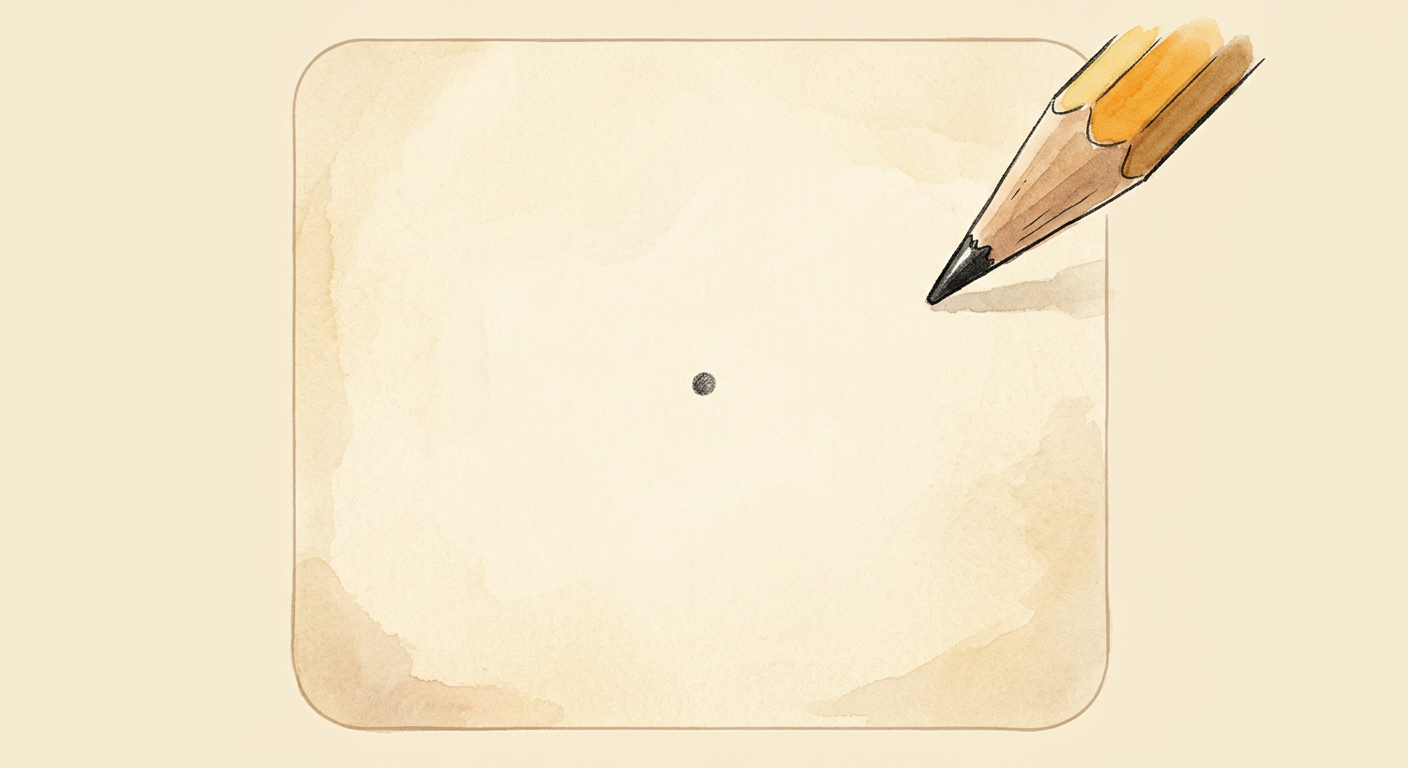
Touch the tip of the pencil to the paper. Press down once and lift.
That mark is a 0D world.
It has a location. It has nothing else. No length, no width, no height. You cannot measure it. You cannot walk along it. There is nowhere to walk to. A being living inside that mark has zero directions available to it. It cannot move. And because it cannot move in any direction, it cannot see in any direction either.
This is the floor of the ladder. Zero directions. Zero ways to move. Zero ways to look.
1D. A Line.
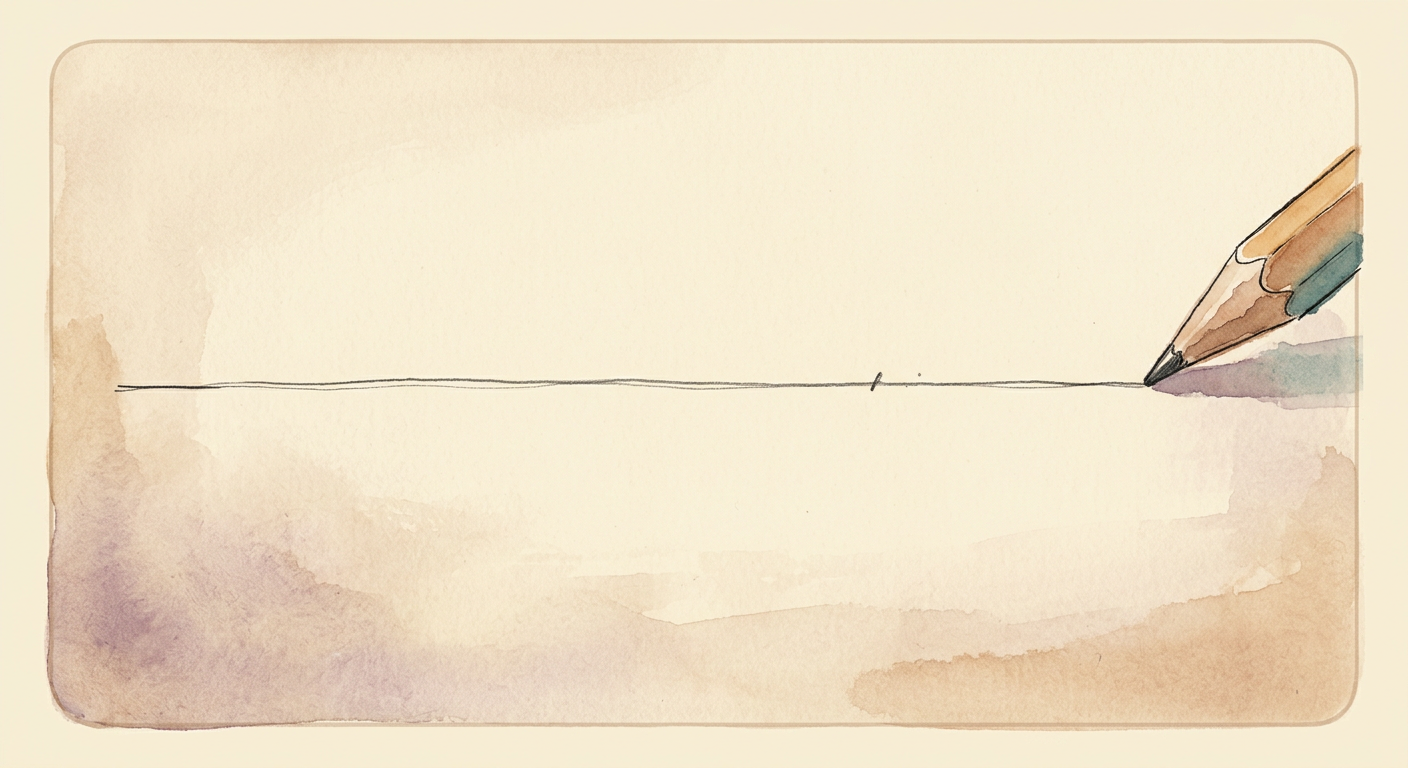
Put the pencil back down and drag it across the paper. A line.
That line is a 1D world.
A being living on that line has one direction available. Forward along the line, or back along the line. There is no awareness of left or right, just forward and back. That's its whole world. Two choices, forever.
Anything off the line might as well not exist. Above the line, below the line, beside the line: none of those are real to the being. It cannot move in them, so it cannot see in them. If you set the pencil tip down half an inch above the line, the being cannot perceive it. The pencil tip is in a direction that, for the being, does not exist.
One direction. One way to move. One way to look.
2D. A Plane.
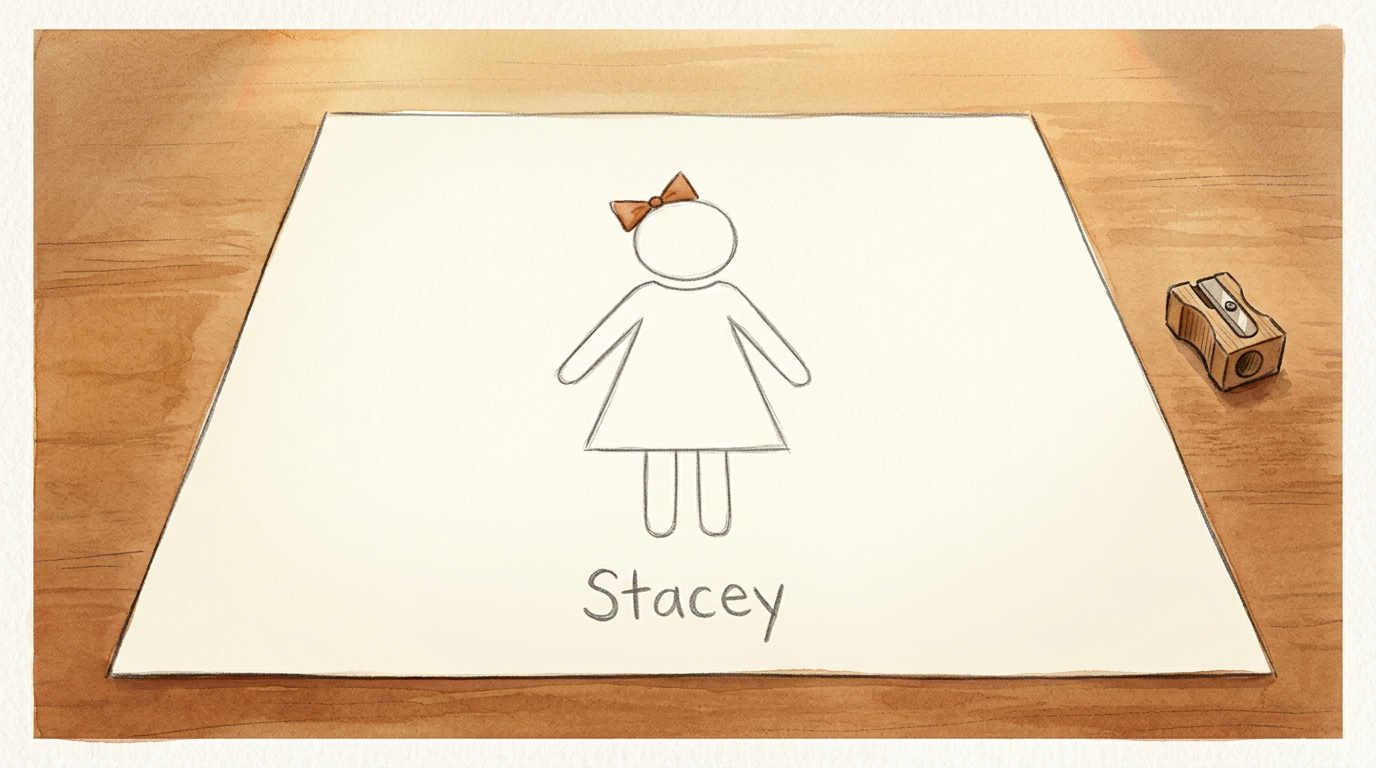
Now draw a stick figure on the paper.
She is a 2D being. Her whole world is the surface of the page. She has length and width. She has no up, no down, and she is completely unaware those directions even exist. The page is everything to her, the way the room around you is everything to you.
Now watch what happens when a 3D being intrudes on her world.
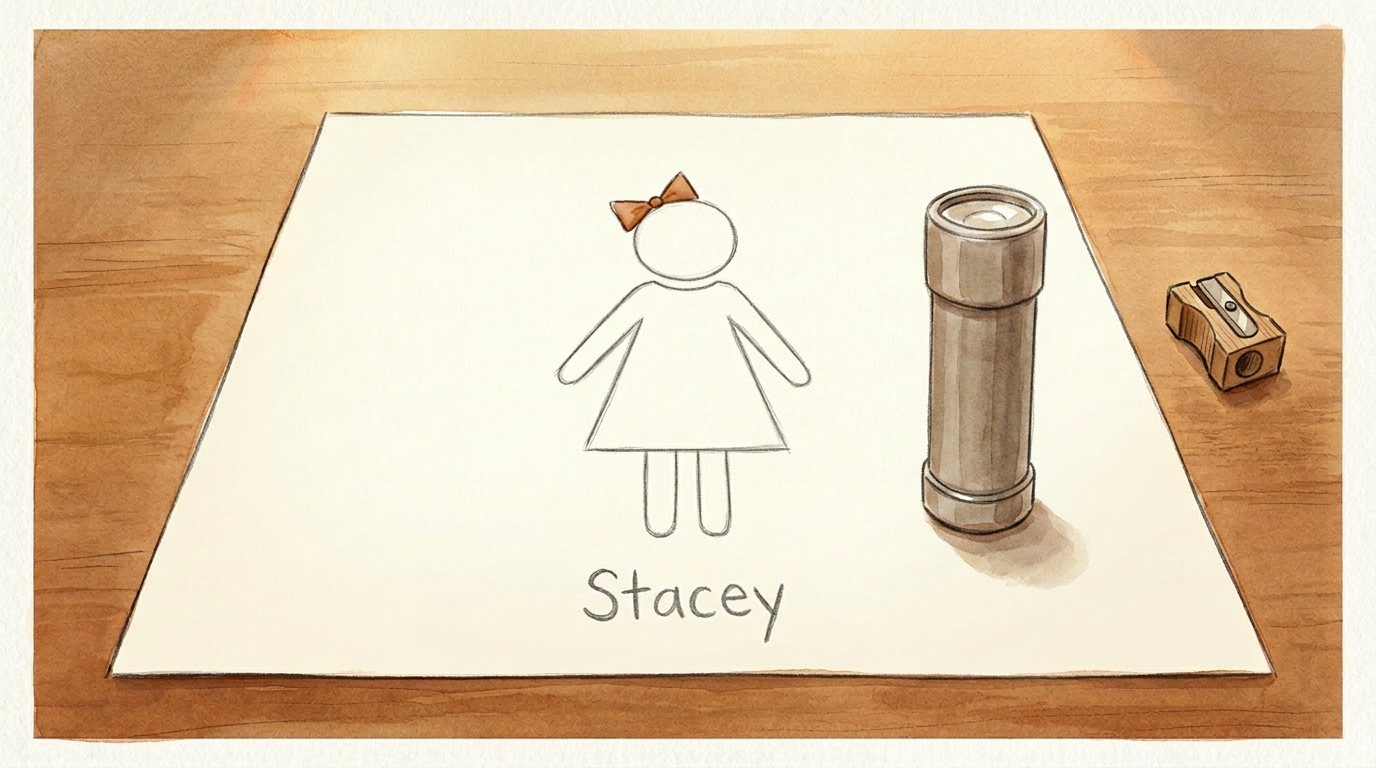
Set the flashlight lens down so it stands upright on the page. The base of the flashlight is where the 3D object intersects the 2D world.
While we, looking down from 3D, see the whole flashlight standing on a piece of paper, Stacey, who is unaware that up and down even exist, sees only the slice of the flashlight that touches her world. She sees a circle.
Not a long metal cylinder. Not a tool with a switch and a bulb and a battery inside. A circle. The only part of the flashlight that exists in her world is the thin slice where it touches her page. The rest of the flashlight, most of the flashlight, is in a direction she has no senses for. Above her page. A direction that, for her, does not exist.
Now lift the flashlight away.
The circle is gone. Not faded, just gone, the moment the slice stopped touching her world. She didn't see it arrive. She didn't see it leave. There was a circle, and then there wasn't.
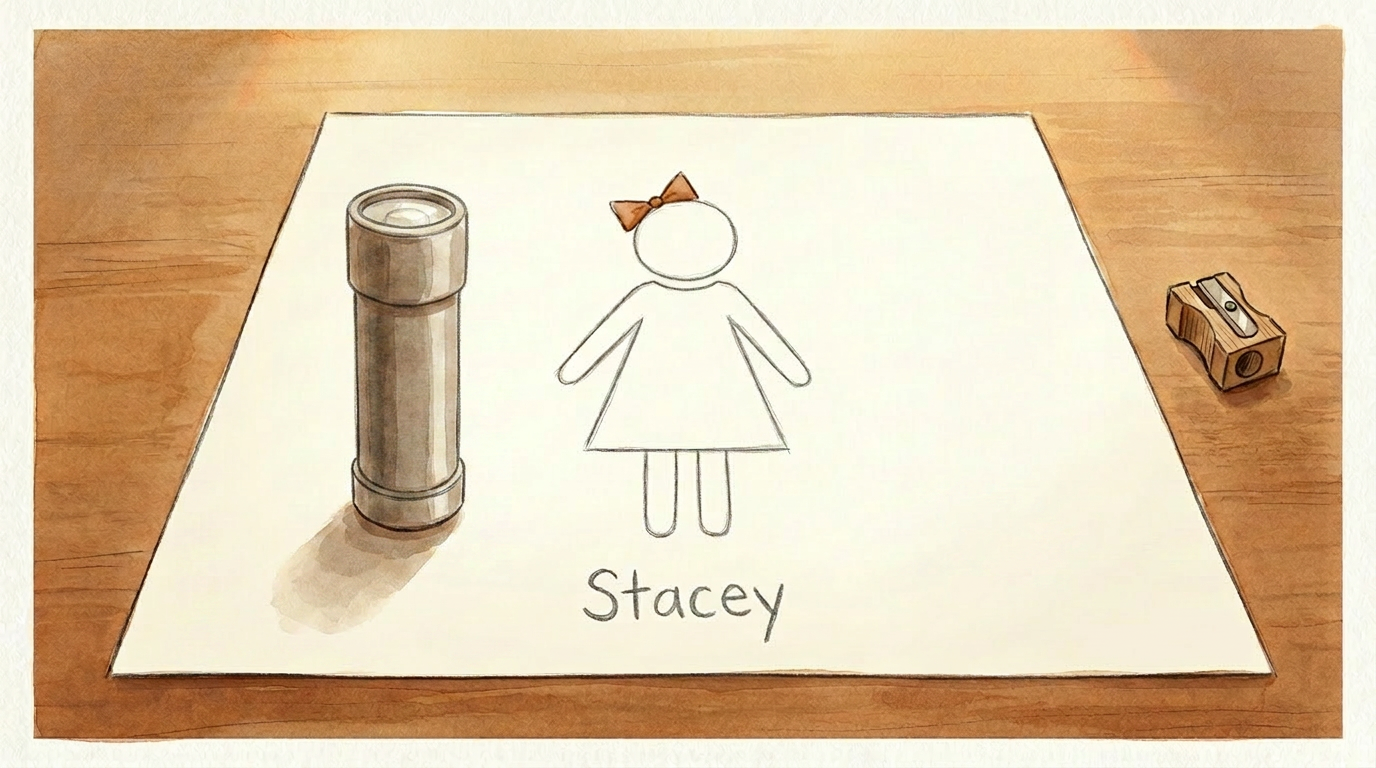
Now stand the flashlight up again, somewhere else on the page.
A circle. Same shape, different location. Lift it away. Gone again.
To Stacey, the same thing was here, then was not here, then was somewhere else, without ever traveling between the two locations. Nothing crossed her world to get from the first spot to the second. There was no path. Just a circle, then nothing, then a circle.
From her point of view, the visitor teleported.
From your point of view, you just picked the flashlight up and set it down somewhere else. The travel happened in a direction she cannot see.
One more demonstration. Then we move on.
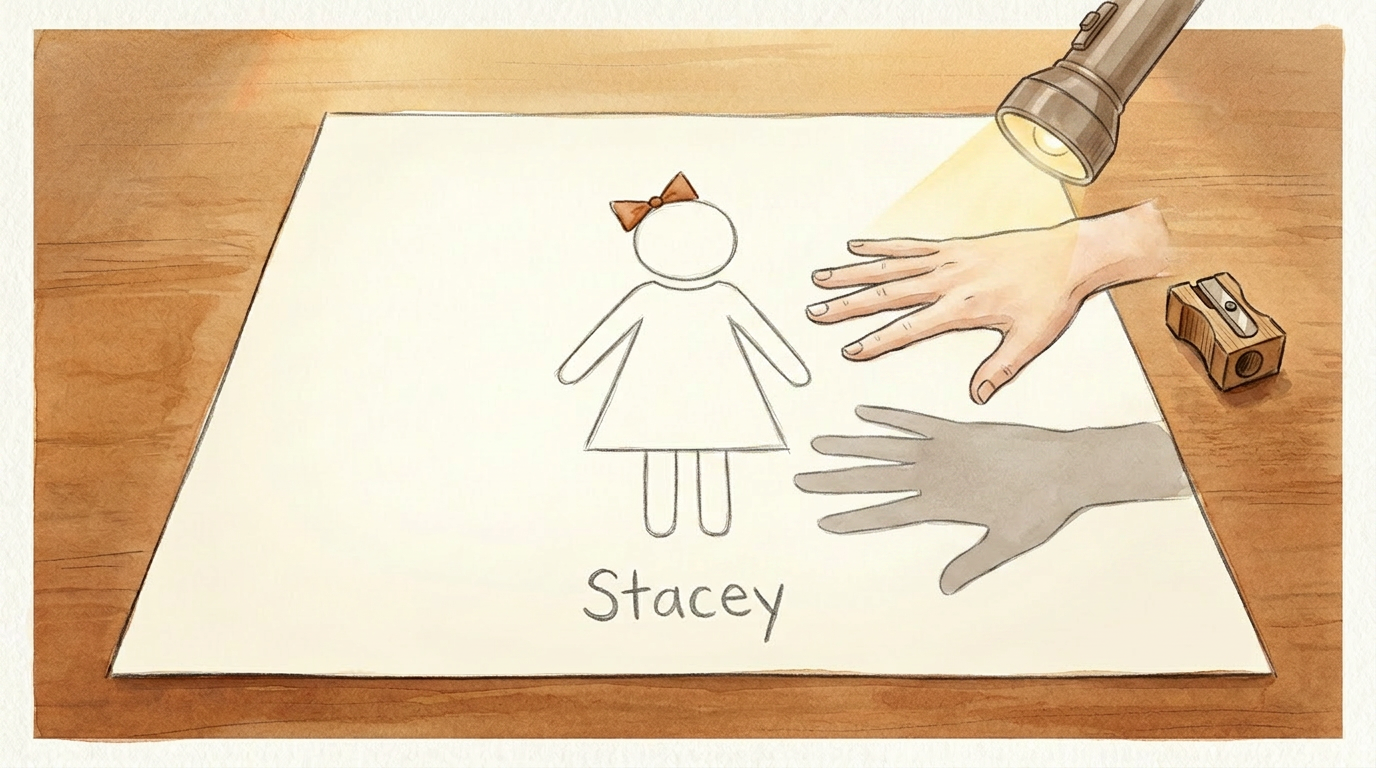
Pick up the flashlight. Turn it on. Hold your hand a few inches above the page and shine the flashlight down on it.
The shadow of your hand falls on the page.
The shadow has the shape of your hand. Fingers, palm, the gap between thumb and forefinger. But it is completely flat. It has length and width and no thickness.
The shadow is your hand, flattened into Stacey's world.
If Stacey could think, she would see a strange shape appear on her page, change as your fingers move, and vanish when you pull your hand away. She would have no concept of above the page. That direction is not real to her. To her, the shadow is just a thing that exists, behaves strangely, and leaves without explanation.
Now put it all together.
The flashlight stood on Stacey's page and she saw a circle. It moved without traveling. The shadow of your hand fell on her page as a flat picture of fingers, then vanished. Neither the flashlight nor your hand ever broke any rule that Stacey could see. They simply moved in a direction that, for her, does not exist.
To Stacey, you are an interdimensional being.
Hold onto that sentence. We are coming back to it.
3D. You.
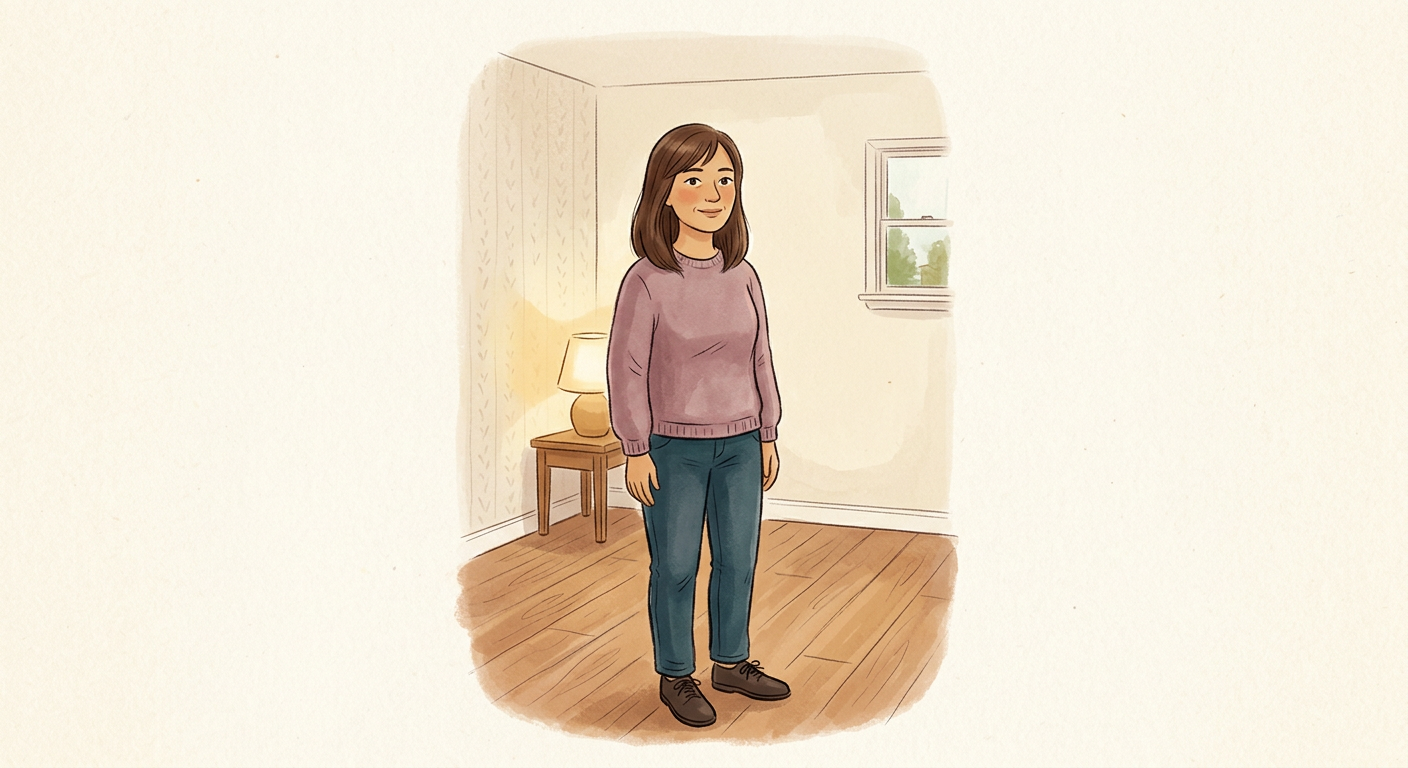
This is you. Right now. In a room.
Your body has three directions of extent. Length (head to foot), width (shoulder to shoulder), and depth (front to back). The room around you also has three directions. The walls are solid. The ceiling is above you. The floor is below you. You feel enclosed. You feel like you're inside something.
This is exactly how Stacey feels on her page. The walls of her world aren't walls she can see, they're the edges of what she has senses for. Her page is everything because up doesn't exist for her. Your room is everything because the direction out of your room, in a way that isn't through the door, doesn't exist for you. Not yet.
You are at the top of a ladder that, from where you are, looks like the top rung.
Everything you just did to Stacey, something one rung up can do to you.
You would see only the slice of it that touches your present moment. You would not see the rest. You have no senses for the direction it lives in. It would appear in your room without arriving, leave without going, and look like nothing you can place.
Not because it's magic. Because of the rule. The directions you can move in are the directions you can see in. And there is at least one direction you cannot move in.
Hold that. We're not done.
4D. The Stack.
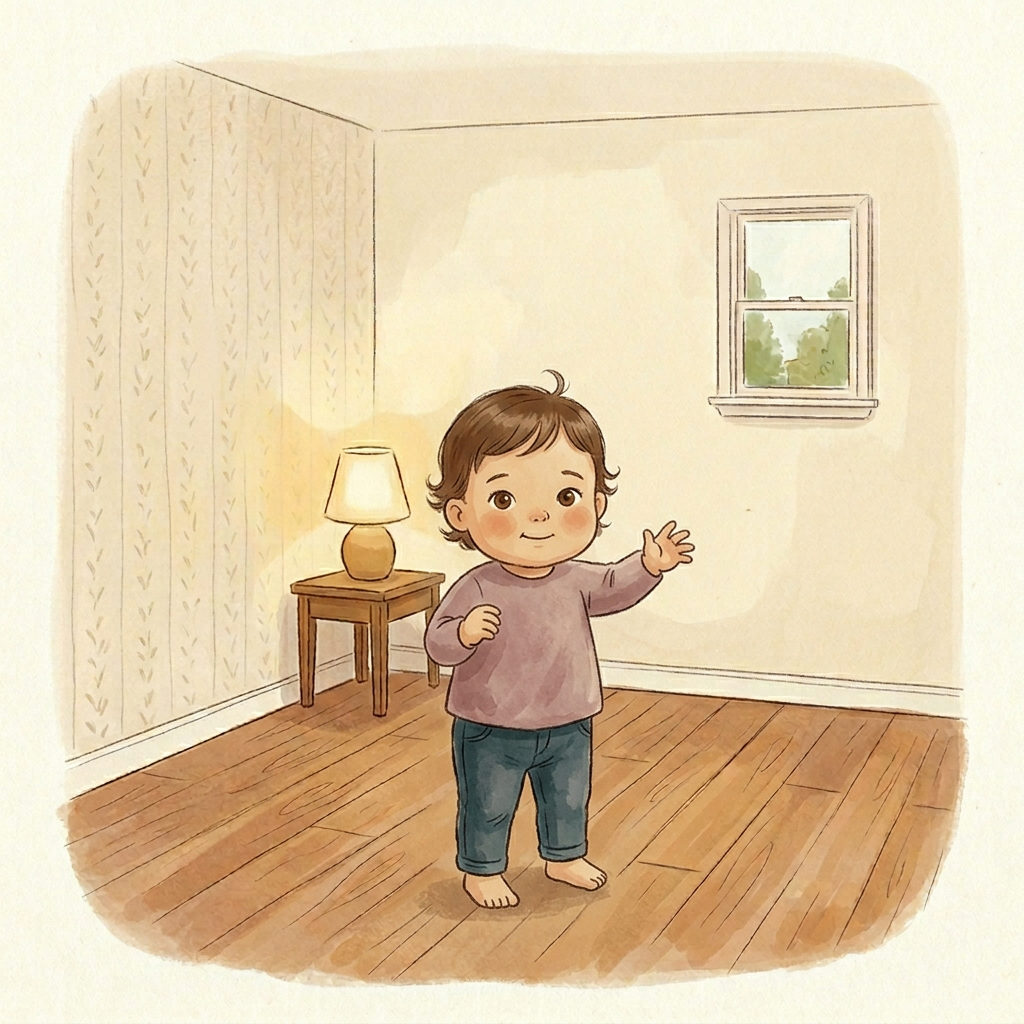
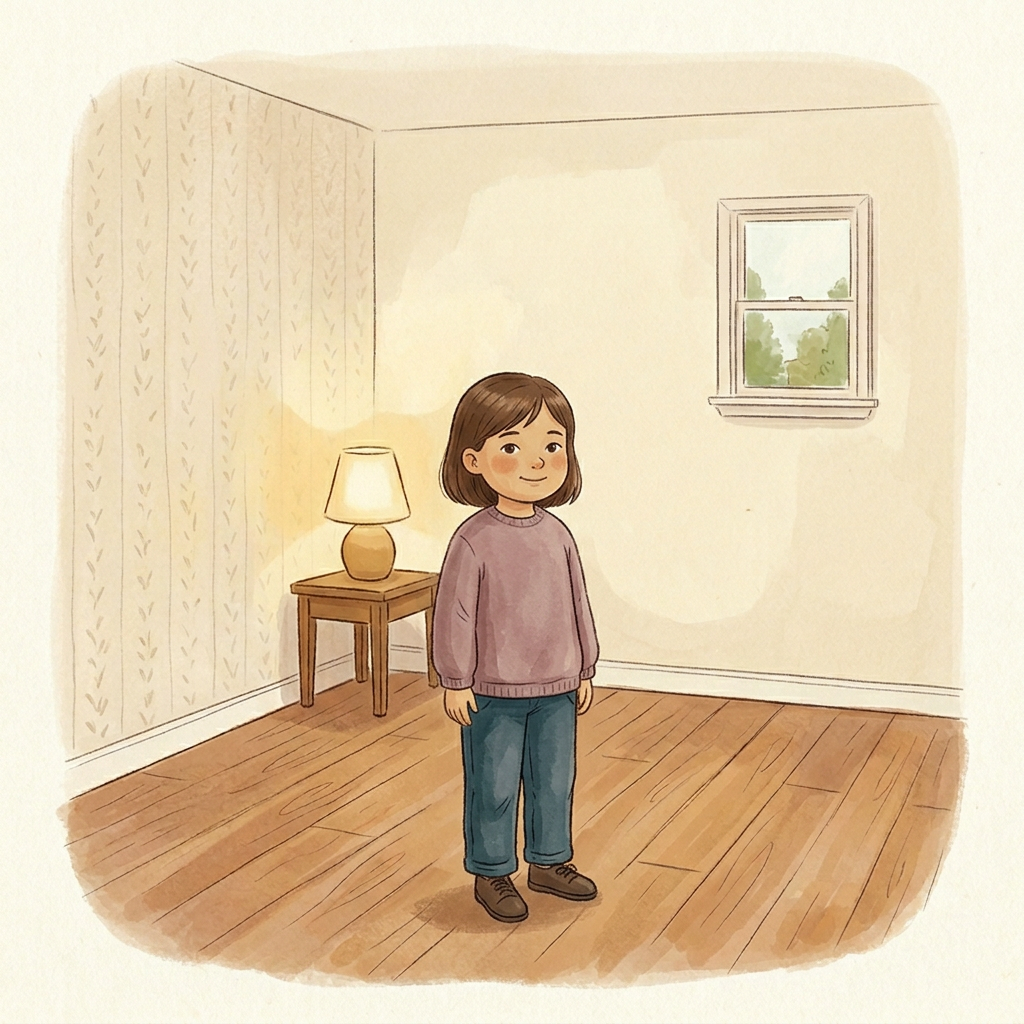
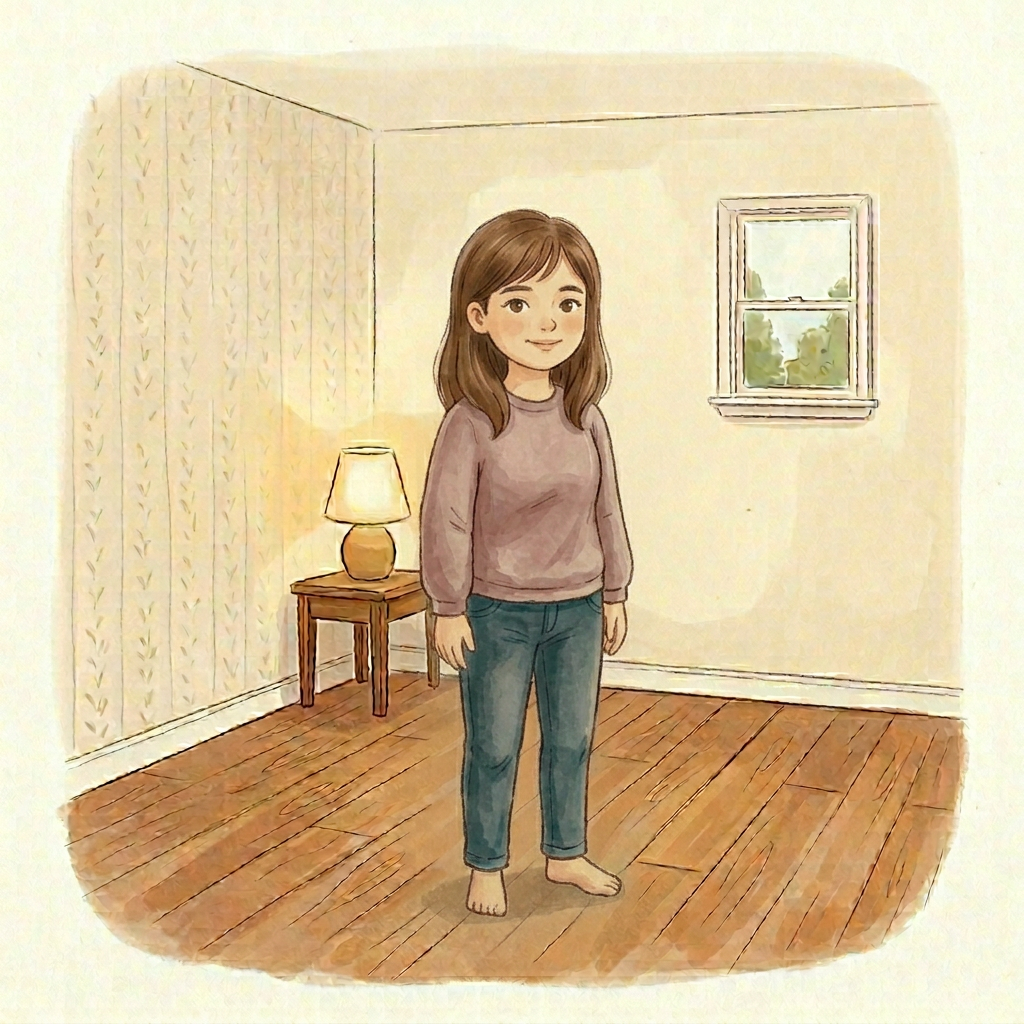
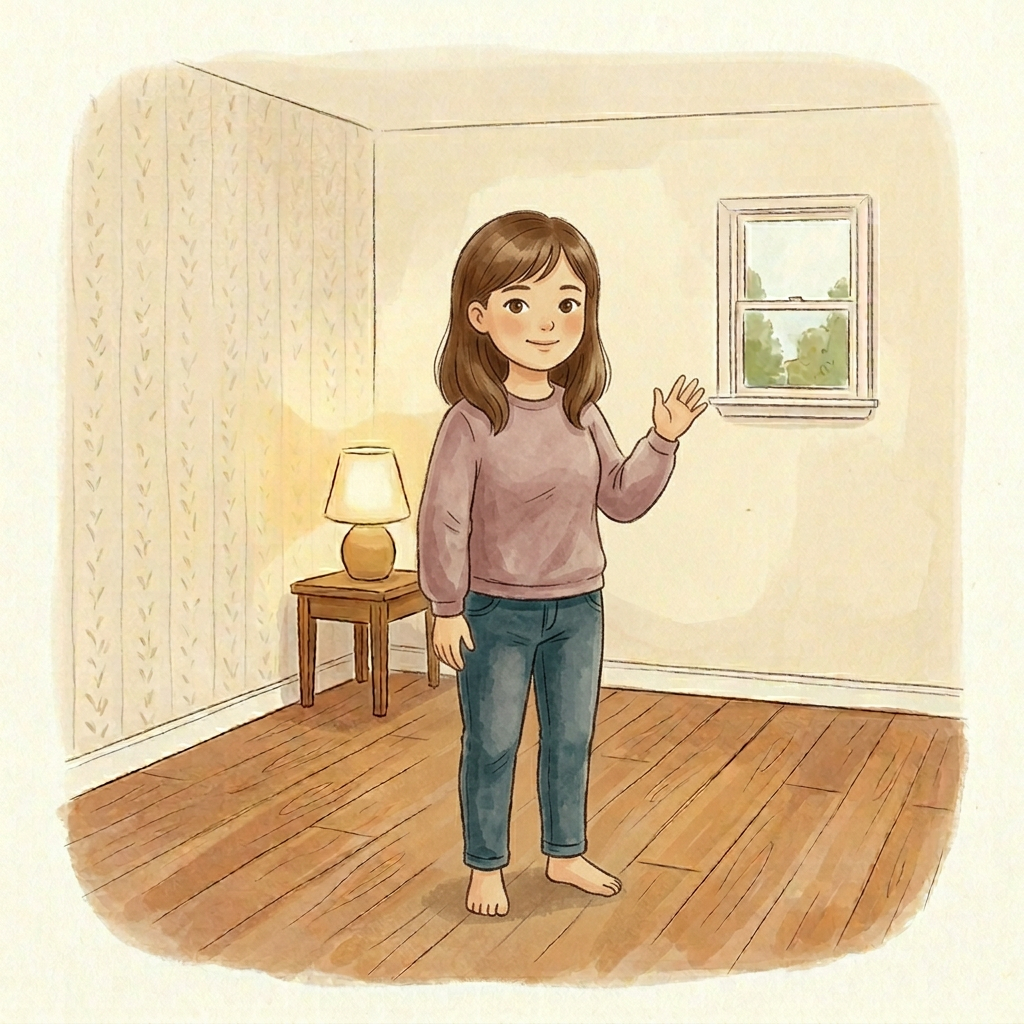
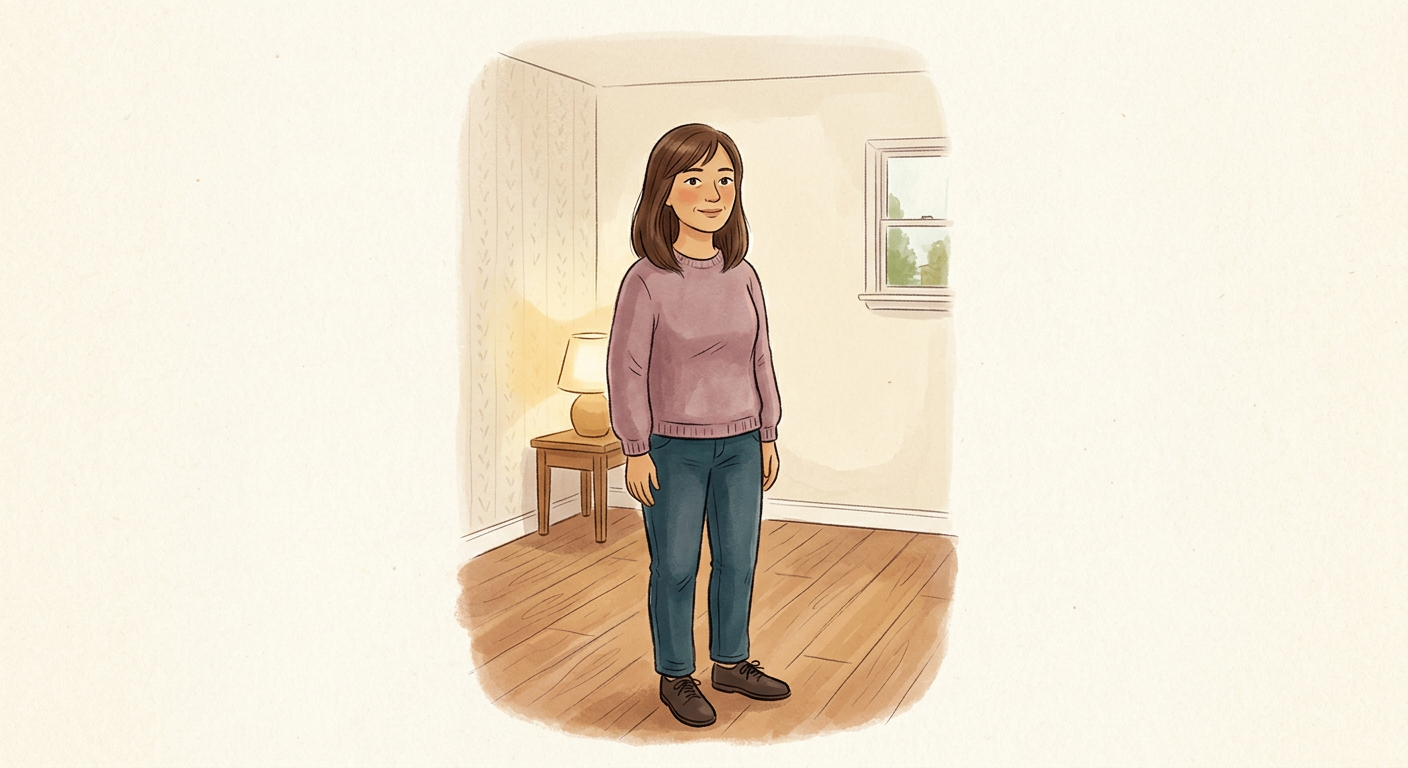
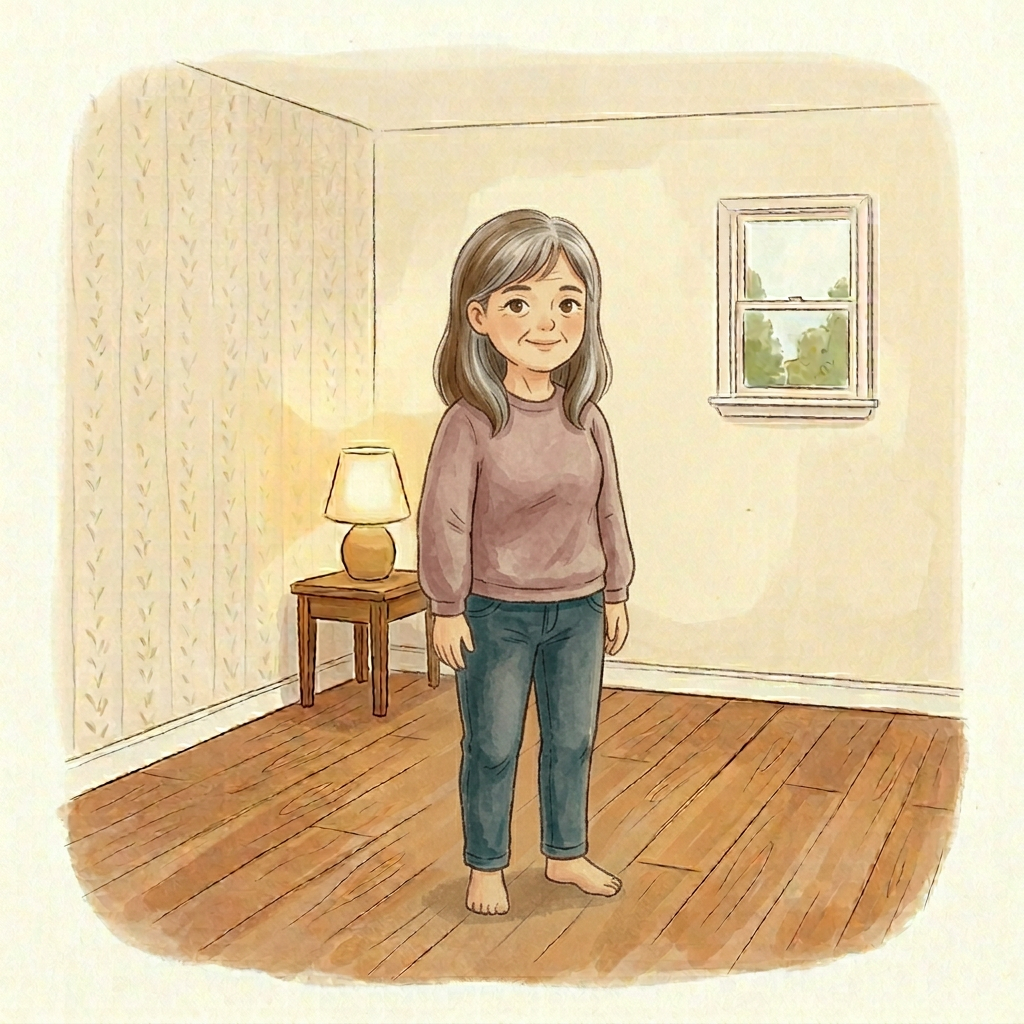
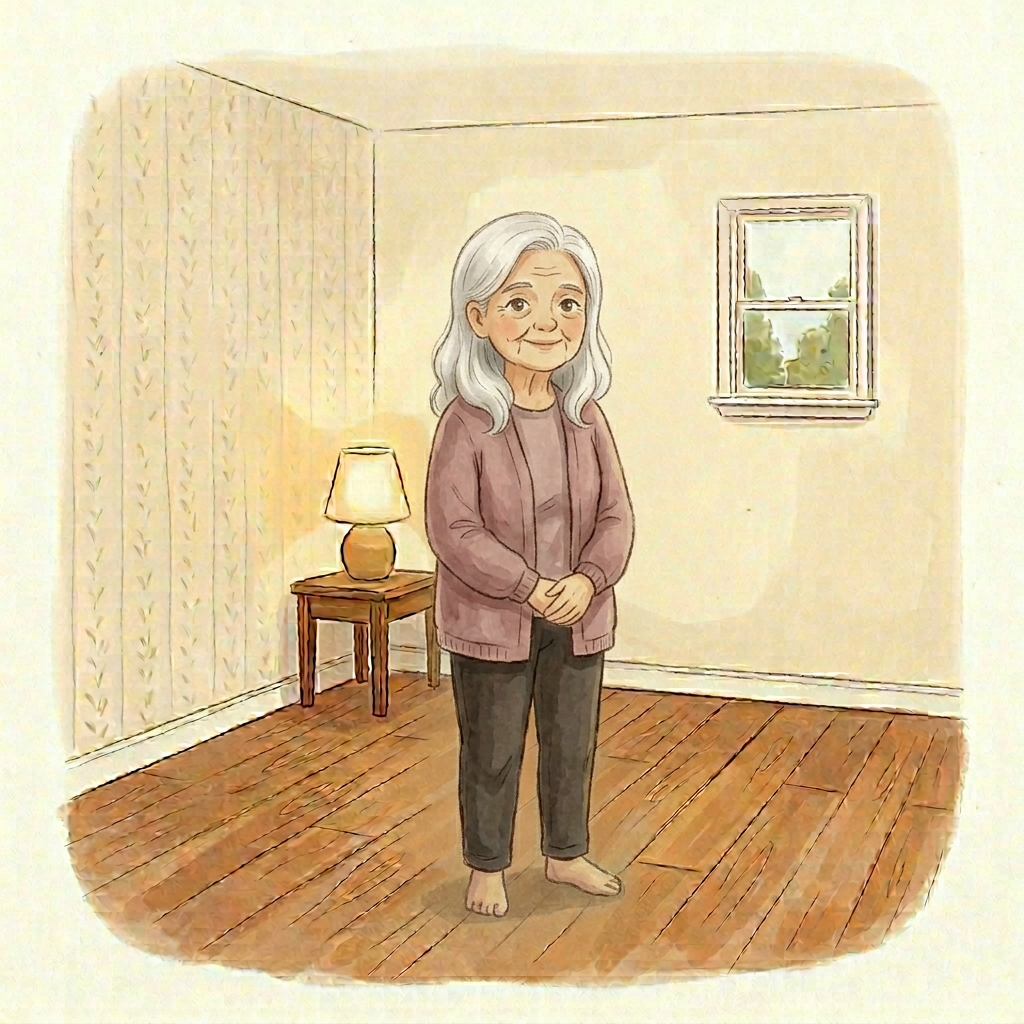
Each of those images is one moment in time. One page. One second of her life.
Now imagine the pages between them. One second after the first, one second after that, one second after that, all the way through. One page per second, for every second of her life.
Stack them.
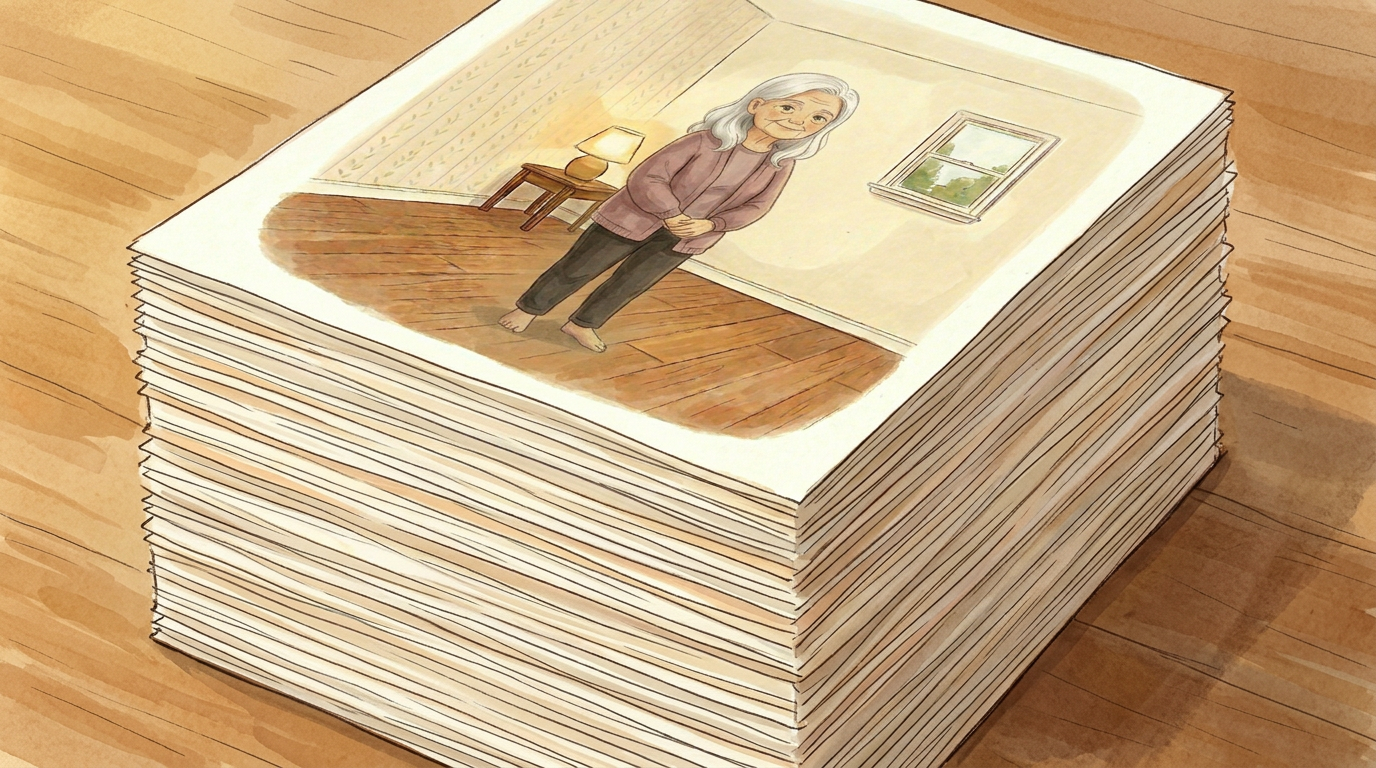
By the end, you have a stack of paper billions deep. Every page is a moment of her. The whole stack is her.
Your whole life is a stack too. First page is the day you were born. Last page is the day you die. Every page in between is a time slice of you, frozen.
You only ever live on one page at a time. The page behind you is the past. The page ahead of you is the future. You can't see either one. You can only walk forward, one page at a time, in the only direction the stack lets you go.
You are to the stack what Stacey is to her page. Stuck in one slice of something bigger.
Now imagine a being standing next to the stack, looking at it from the side.
They see every page at once. Your whole life, all of it, laid out the way you'd see the pages of a book stacked edge-on.
To them, your life is a single object.
Your birth and your death are equally visible. To you, your future hasn't happened yet. To them, it's already part of the shape. They aren't predicting it. They're looking at it.
This is what the aliens in Arrival are, if you've seen the movie. Their language has no tense because tense is a 3D problem. When you can see every page of someone's life at once, was and will be are not different. They are just parts of the shape. The movie's main character starts to learn the language and starts to see her own life that way too. Not predicting the future. Looking at it.
If you haven't seen the movie, that's the idea: a being who experiences time the way you experience a room.
A 4D being can reach into your stack from the side and touch any page they want. A Tuesday afternoon when you were thirty-eight, for instance.
From your point of view, on that Tuesday afternoon, something appears in your room. It wasn't there a moment ago. Now it is. It seems to know you're there. After a while, it's gone.
From their point of view, they were always touching that page. They never moved. You're the one moving, forward through the stack, one page at a time.
5D and Up. The Library.
Take the stack from the last rung. Your whole life, page by page.
Bind it. Glue the spine.
The stack is now a book. One book, one life, every moment a page.
A stack and a book are the same object. The book is just easier to picture on a shelf.
For some readers the library will already be visible. For others, here's what it looks like.
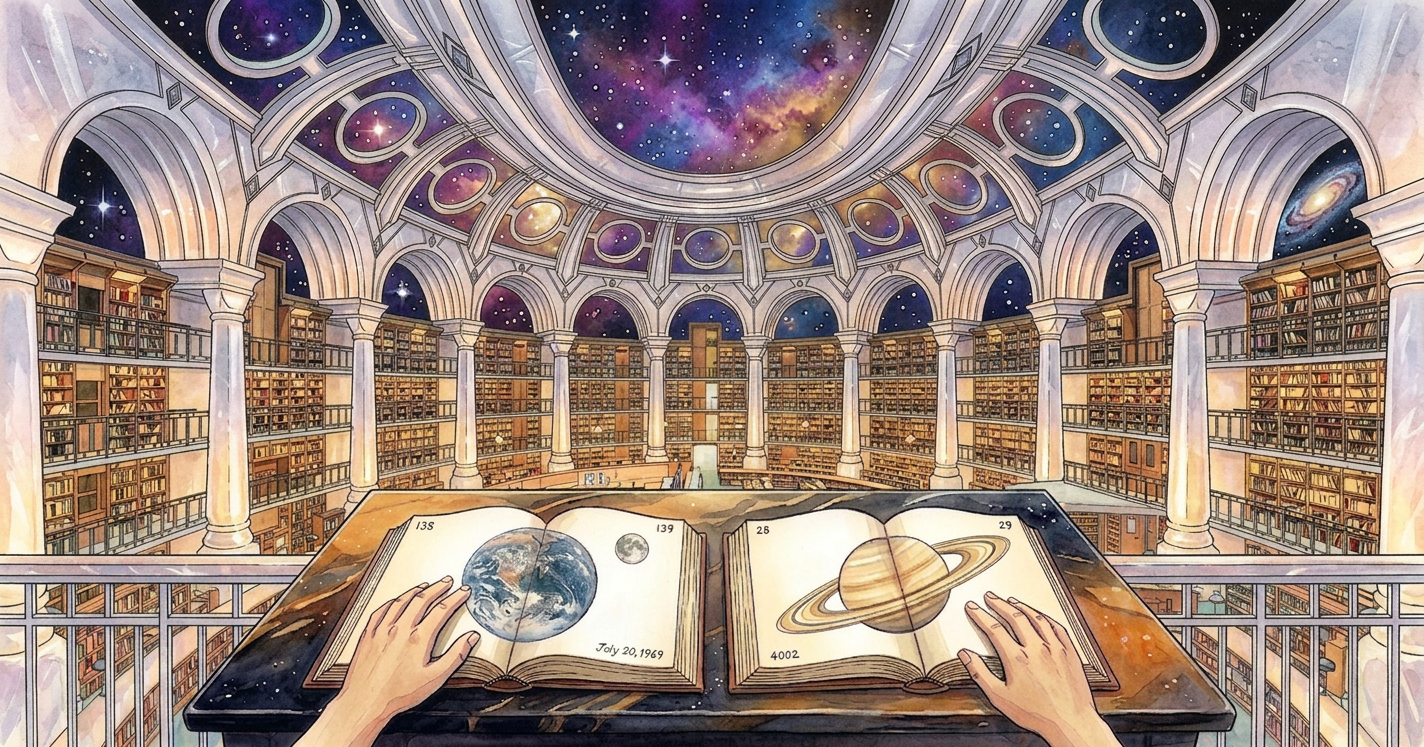
Now imagine a library.
Every book is one location's worldline. The book on this shelf is your kitchen, from the moment the floor was laid to the moment the house comes down. The book next to it is the sidewalk outside. The book three shelves over is a beach in Portugal. The book at the end of the aisle is the surface of Mars.
Every place that has ever existed, or will ever exist, is a book on a shelf in this library.
A being who walks the aisle can pull any book, open it to any page, and be there. Page 138 of one book is a Tuesday afternoon in your kitchen when you were thirty-eight. Page 29 of another book is a foggy morning on the Golden Gate Bridge in 1971. Four steps down the aisle, switch books, and the being is there.
No travel. Just navigation.
You cannot walk the aisle. You are inside one of the books. Your senses point along your three directions and forward through your pages. The aisle is perpendicular to all of that. It's a direction you have no word for, because you have no senses for it.
And if the aisle is real, which is what frameworks like Randall-Sundrum propose, something walking it can do exactly what the rest of this piece has been building toward.
To Stacey, you were an interdimensional being. To something walking the library aisle, you are Stacey.
A 5D being doesn't travel from your kitchen to Portugal. They close one book, walk four steps, open another.
A 5D being doesn't wait twenty years to see how a story ends. They flip the pages.
From inside the books, both motions look the same: something was here, then was not here, then was somewhere else, with no path between them.
We have been describing that pattern since the second rung.
If a being like this visited our world, what would we see?
Things appearing in our skies without arriving. Things disappearing without leaving. Things showing up in two places at once, or in the same place across centuries. Things that seem to know what's coming, because the next page is already there for them to read. Things that ignore the laws of motion as we understand them, because those laws describe what's possible inside the book. The library aisle is not inside the book.
What about more than five dimensions?
Physics doesn't stop at five. But past five the math is doing the work and the pictures stop helping. That's a different climb than this one.
Here's the short version of what's up there.
The universe runs on two sets of rules that don't agree with each other, one for the very big and one for the very small, and most of modern theoretical physics is the search for one set of rules that covers both. String theory is the leading candidate. It needs ten dimensions to work. M-theory, a deeper version that pulls several string-theory variants together, needs eleven. The math requires them, but the math doesn't tell us where or what they are.
So whose math is this, anyway?
Up to this point, when we've said "dimension," we've meant a direction something could move in. From here on, the people you're about to meet were doing something different. They were treating dimensions as variables in equations, coordinates the math keeps track of, whether or not anything could ever walk along them. Sometimes those variables turn out to point at real physical directions. Sometimes they don't. Sometimes they do, but the directions are folded too small to ever reach. The math doesn't care which. It just needs the dimensions to be there for the equations to work.
This is where the framework starts paying off in ways nobody saw coming.
Edwin Abbott, in 1884, was a schoolmaster in London with no formal physics training. He wrote a short novel called Flatland, in which a square living in a two-dimensional world is visited by a sphere from three dimensions. The sphere appears to the square as a circle that grows, shrinks, and vanishes. It returns somewhere else. The square cannot conceive of the dimension the sphere is moving in. Abbott was writing satire. He was also, without intending to, building the visual playbook every dimensional physicist after him would use. The flashlight on Stacey's page is Flatland. So is the rest of this piece.
Albert Einstein and Hermann Minkowski, between 1905 and 1908, did something nobody had ever seriously proposed before. They took time, which physicists and philosophers had always treated as a separate thing from space, and folded it into the same mathematical object. Spacetime. One four-dimensional fabric. Their equations described how that fabric curves around mass, and how that curvature is what we feel as gravity. The 4D stack from earlier in this piece is not a metaphor invented to help you visualize physics. It is how every working physicist on Earth describes the universe.
Theodor Kaluza and Oskar Klein, in the 1920s, tried something strange. Einstein had just finished describing gravity as the curvature of four-dimensional spacetime. Kaluza added one more dimension to Einstein's equations, just to see what would happen.
What happened is that electromagnetism, the entire physics of light and electricity and magnetism, fell out of the math on its own. Nobody put it there. It appeared as a side effect of the geometry, the moment you added a fifth dimension. Two separate forces, gravity and electromagnetism, became one thing seen from different angles.
Klein later worked out a possible explanation for why nobody had ever noticed a fifth dimension lying around. It was, in his proposal, curled up incredibly small at every point in space, too tight for anything our size to detect. The garden hose, almost a hundred years before anyone needed the analogy for string theory.
The fifth dimension stayed in the framework.
String theorists, starting in the late 1960s and continuing today, ran into a stranger version of the same trick. The math of their theory only worked, was only mathematically consistent, if the universe had ten dimensions. Not nine. Not eleven. Ten. Nobody chose that number. The equations refused to balance otherwise.
Edward Witten, who later showed that all five competing versions of string theory were the same theory seen from different angles (and named the unified version M-theory, which needs eleven), is widely considered the most mathematically gifted physicist alive. Leonard Susskind built much of the foundation. Brian Greene wrote The Elegant Universe, a four-hundred-page tour through why the math works the way it does. These people have spent their entire careers on the implications of dimensions you cannot see.
Lisa Randall and Raman Sundrum, in 1999, proposed something almost too neat to be true. They suggested that our entire universe, all three spatial dimensions of it plus time, could be sitting inside a larger five-dimensional space, the way a sheet of paper sits in a room. Our matter, light, and forces would be stuck to the sheet, unable to escape into the larger space. Gravity, uniquely, would be able to leak out. This would explain, among other puzzles, why gravity is so much weaker than every other force in nature.
Their paper has been cited tens of thousands of times. It is not fringe. It is mainstream theoretical physics, taught in graduate programs worldwide. The library and the books in this piece are, almost exactly, what they were proposing.
None of these people would tell you they have proof that interdimensional beings exist. That is not what the framework claims. What the framework claims is that if something existed on a higher rung of the ladder, it would do exactly the things people have been describing for as long as people have been describing them. The math doesn't require those beings. The math just doesn't rule them out.
The takeaway
Here is what you now know.
A dimension is a direction you can move in. Not a parallel world. Not an alternate reality. Just a direction.
The directions you can move in are the directions you can see in. Where you cannot move, you cannot see.
Each rung of the ladder adds one more direction. Stacey on her page has two. You in your room have three. Time gives you a fourth, but you can only walk it forward, one second per second. Above that, there is the library, and at least one direction perpendicular to everything you have ever known.
You are on a rung. If higher-dimensional intelligences exist, they would occupy a rung above ours the way we occupy one above Stacey. That isn't an opinion. That's the geometry.
A higher-dimensional being would not automatically be wiser, kinder, or more advanced. A 3D human is "higher-dimensional" relative to Stacey, but that does not make humans virtuous, ethical, or omniscient. It only means we have access to one additional direction. The ladder describes geometry, not virtue.
When someone in a hearing says interdimensional being, this is what they should mean. A being with access to a direction we don't have. Not a ghost. Not a wizard. Not a being from a parallel universe. Just a being with one more direction available, doing exactly what a being like that would have to do to interact with us.
Whether such beings exist is a different question, and a harder one. This piece doesn't answer it.
What this piece does is take the word out of the realm of spooky and unexplained and put it where it has always actually lived. In geometry. In physics. In the same toolkit Einstein used to describe time.
The ladder was always there.
The only thing that just changed is that you now know where you are on it.